AGO Congelo
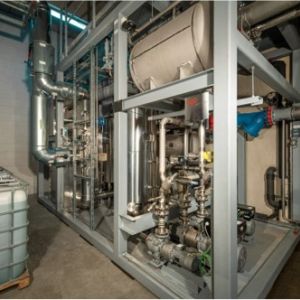
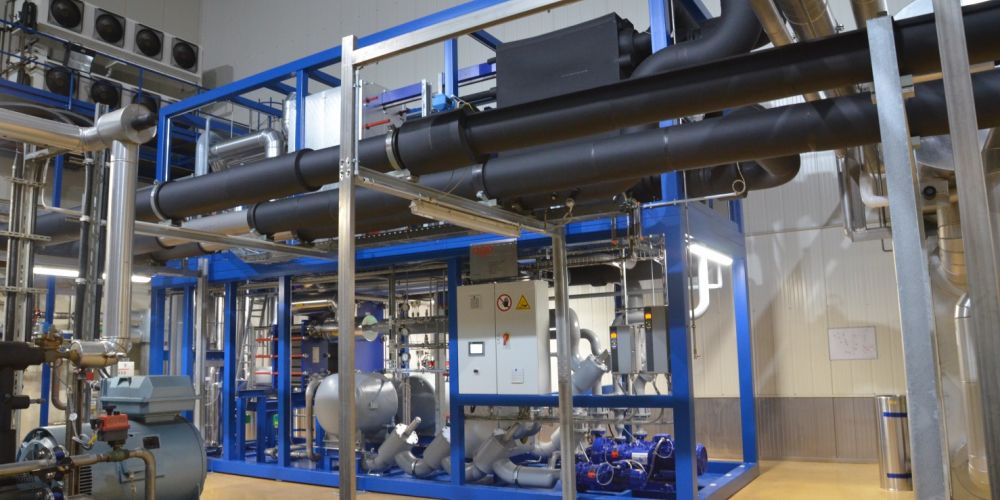
Absorption refrigeration machines
Generate your normal and low-cold with absorption refrigeration machines that are driven with heat instead of electricity.
Have a large cold requirement at temperatures between 5 °C and -40 °C?
Would you like to Energy costs for cold generation reduce?
Would you like away of Synthetic refrigerants?
Standing waste heat available from power generation or industrial processes?
Yeah?
Then use your heat as a drive for cold generation with a AGO Congelo Absorption refrigeration machine.

Ideally suited for industries such as
- Food storage and logistics
- beverage industry in particular breweries
- Dairy
- Normal cooling bearing and frozen bearing
- Fruit and vegetable storage
- Meat processing industry
- Large bakeries
- Chemical industry
- pharmacy

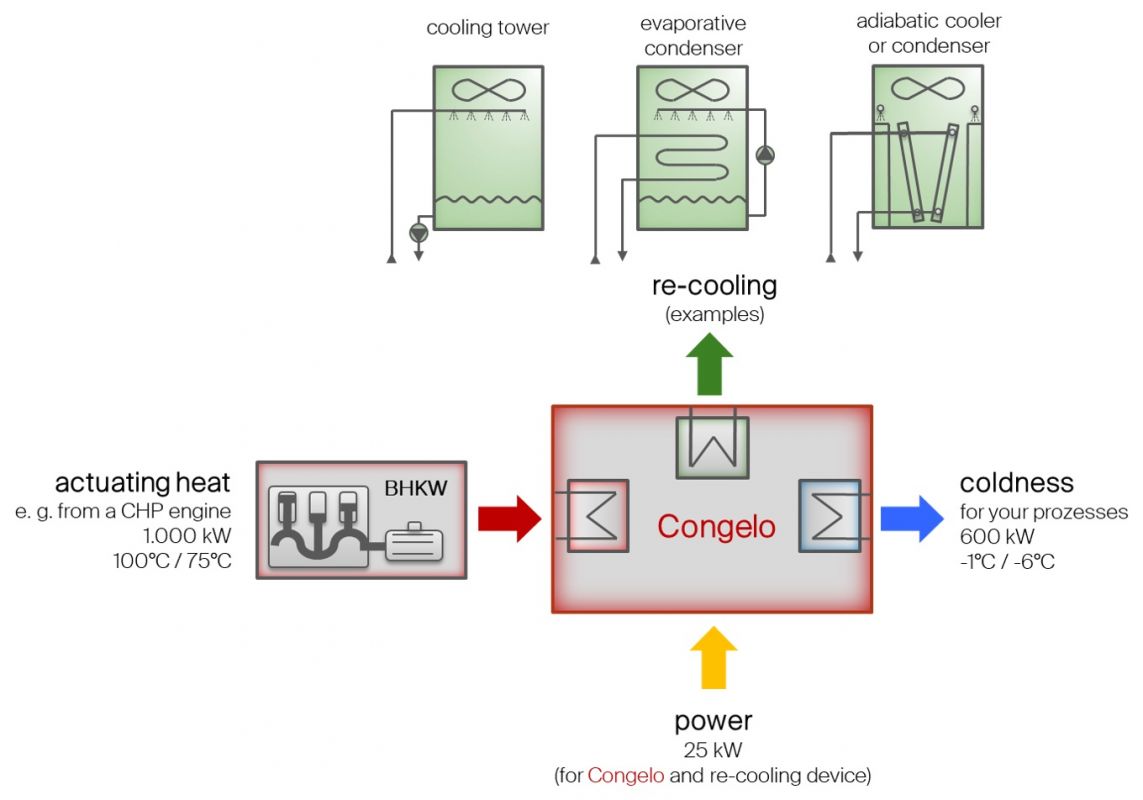
Useful heat sources
- Heat as a by-product of power generation
- CHP plants, gas turbines, ORC circuits, steam turbines
- Process waste heat
- Compressed air generation, hot gas cooling, low pressure evaporation, product cooling etc.
- Regenerative heat such as solar thermal energy or geothermal energy
Technical data
We manufacture the AGO Congelo suitable for your requirements:
- Heating heat supply temperature: approx. 90°C to 160 °C
- Heating heat return temperature: min. 70 °C
- Heating heat output: approx. 200 kW to 3,000 kW
- Cooling capacity (year Ø): approx. 100 kW to 1,500 kW
- Cold temperature: 5 °C to -40 °C
- Heat ratio in the annual average: about 0.4 to 0.6 (cold power/heating power)
- Different cooling options:
- Adiabatic Recooler
- Hybrid recoolers
- Evaporation cooler
- liquefying agent
- Electricity requirement including recooler: 5% of refrigeration capacity
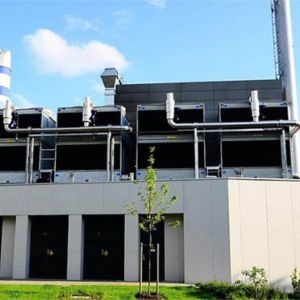
- Installation variants: interior, exterior, container
How does an absorption refrigeration machine work?
The mode of operation of absorption refrigeration systems is based in principle on a thermodynamic circular process.
This makes it possible to absorb heat from a low temperature level (cooling of a cold carrier) to bring this energy to a higher temperature level and to release it again (recooling) without requiring significant electrical energy as a drive.
The basic principle of absorption refrigeration machines was already registered as a patent in 1859 by Edmond Carré on the basis of the substance pair ammonia/water.
Compared to a compression refrigeration machine, the refrigerant compressor contained therein is replaced by a solution circuit, which is also called thermal compressor.
The cold part of the absorption refrigeration machine is comparable to that of a compression refrigeration system. A refrigerant compressed to high pressure, in our case ammonia, is condensed in a liquefier, thereby giving heat to a recooling circuit and ultimately to the environment.

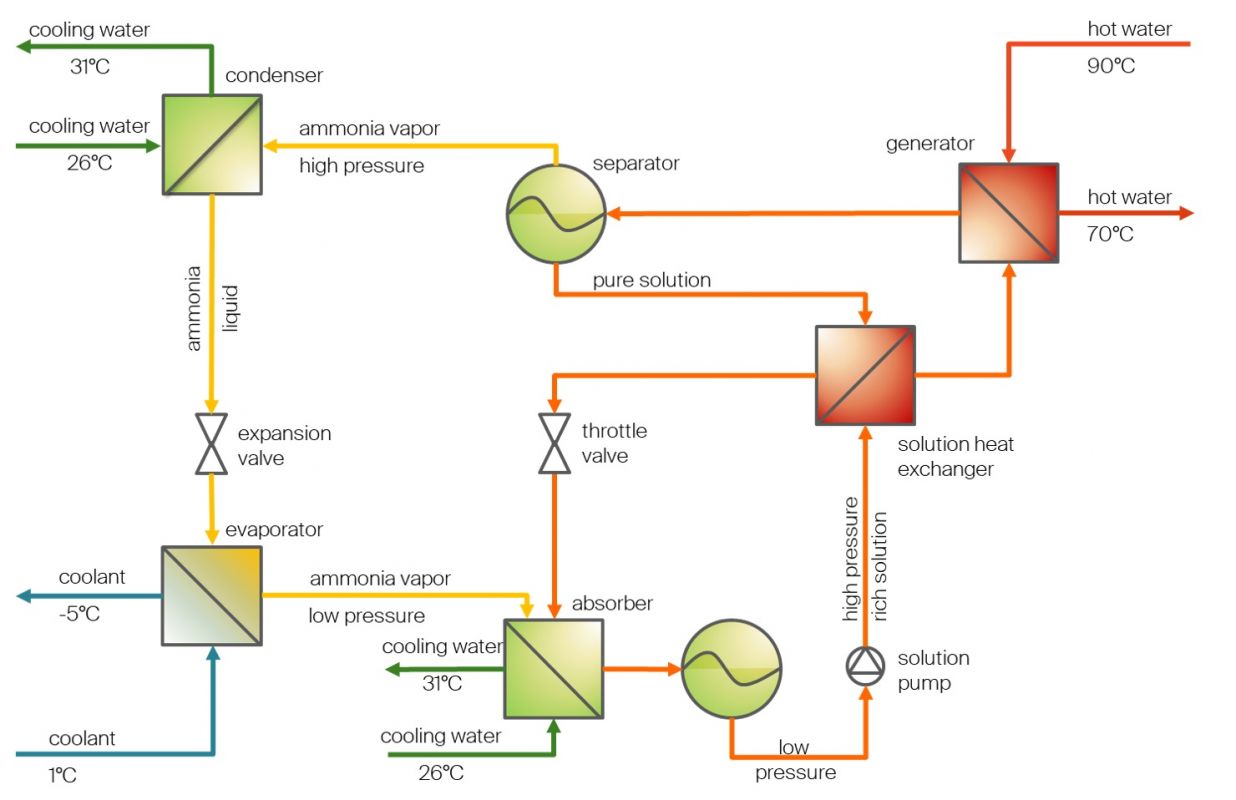
The liquid refrigerant is then cooled in an internal heat exchanger, which increases the efficiency of the machine. The refrigerant is then expanded from high pressure to low pressure with an expansion valve. As a result, the temperature of the liquid refrigerant drops to the evaporation temperature of the low pressure.
At this low temperature, the refrigerant absorbs heat from a refrigerant circuit and evaporates. The useful refrigeration capacity is produced and the cold carrier is cooled.
The evaporated refrigerant with even low temperature is overheated in the internal refrigeration/heat exchanger. In compression refrigeration systems, the compressor would now come, which would compress the vapor-shaped refrigerant from low pressure to high pressure.
In absorption refrigeration machines, however, the property is used that the refrigerant dissolves ammonia very well in the solvent water. This is done in the absorber.
The vaporous ammonia is brought together there with the ammonia-containing aqueous solution, whereby the ammonia dissolves in the water and the ammonia concentration of the solution increases.
Heat is released during this process. The higher the temperature of the solution, the less ammonia can dissolve in the water. For this reason, the absorber is cooled. This waste heat is also delivered to the environment via the cooling circuit.
After the absorber, an ammonia-rich solution is present which can be pumped from low pressure to high pressure with a simple pump. Due to the incompressibility of a liquid, the current requirement of this pump is only a fraction of the current requirement of a comparable cold compressor.
Since the solubility of ammonia in water depends only on the pressure and the temperature, the ammonia recovers from the liquid even at high pressure if the temperature is increased only far enough. For this purpose, the rich solution is first preheated in a solution heat exchanger by internal heat recovery and then reaches the extractor.
In this system, the actual drive energy is supplied to the system. The solution is heated with the drive heat, which e.g. comes from a CHP, until the ammonia evaporates again. In the separator, the vaporous ammonia which flows upwardly to the cold section of the absorption refrigeration machine then separates from the ammonia-containing solution.
This solution is precooled in the solution heat exchanger and then expanded to low pressure in the throttle valve before it is returned to the absorber.
Reduce your operating costs and your CO2 footprint!
The intelligent use of your waste heat not only reduces your costs. They thus make a sustainable contribution and have many other advantages:
- The machines have only little moving parts. This results in low maintenance costs.
- The system is reliable and has a long service life. The piping and the containers are made of stainless steel.
- High efficiency thanks to patented circular process variants, even at unfavorable temperature conditions
- Use of natural refrigerant (GWP = 0; ODP = 0)
- Supportable (KfW, Bafa, etc.)
- Stepless control in the range of 30 % to 100 %
Economics and finance
The cost-effectiveness of these systems depends on legal, energy-economic and technical conditions, the current funding situation and project financing. We are happy to support you in the cost-effectiveness calculation and comparing different variants. We provide you with information on the reduction of greenhouse gas emissions.
Together with RheinEnergie AG we can also create a contracting offer with the following advantages:
- The investment financing, as well as the plant and operating risk, is at RheinEnergie AG.
- The investment does not run over your balance sheet.
- The plants are operated and maintained by experts for energy supply systems.
- You can focus on your core business.
- High plant availability can be assured.
Request data:
Your application is unique. The AGO Congelo is planned and manufactured precisely for your application. For interpretation, we need the following parameters:
- Available heat output or desired cooling performance
- Pre- and reflux temperature
- cold carrier outlet temperature
- site or Cooling water temperatures
- Installation variant (internal, external, container)
Benefit from the support programs of the Bafa and the KfW for the construction of your thermal engineering system!
We are happy to advise you!